When running an industrial operation, you are constantly in search of reliable equipment.
The choice of the mounting style for your machinery, in fact, may have a greater impact than you think.
The flange motor is the answer here, and believe me, once you get to know the unique features of these motors, you will understand why a lot of facility managers are switching over to flange motors.
What Is a Flange Motor Anyway?
To begin with, a flange motor is an electric motor, to be precise, that is attached directly to your equipment through a round flange.
See it this way: instead of being supported by feet like a conventional motor, it mounts against your machinery face-wise, thus forming a strong, direct link.
The design of the flange mounted motor might look trivial, but in fact, it changes everything in terms of motor operation.
No matter whether you are working on the conveyors, pumps, or any kind of industrial equipment, mounting styles like this one that let you directly couple the motor to the driven equipment offer you a considerable gain in performance and reliability.
Why You Should Care About Flange Motors
Here is a fact that a flange motor consumes much less space than an ordinary motor, which is the reason that every factory manager gives his consent to it.
Without those mounting feet sticking out, you’re freeing up valuable floor space.
I’ve seen facilities reconfigure entire production lines just because switching to flange motors gave them the extra space they needed.
In today’s manufacturing world, where real estate costs keep climbing, every square foot you can reclaim is money in your pocket.
Plus, when you’re designing modular equipment or mobile machinery, that compact footprint becomes even more critical.
Perfect Alignment Every Single Time
You know that annoying vibration issue that keeps causing bearing failures?
Nine times out of ten, it’s an alignment problem. The beauty of a motor flange system is that it practically aligns itself.
The rigid, direct mounting means your motor shaft and driven shaft stay lined up exactly where they should be.
I’ve talked to maintenance teams who’ve told me their vibration issues disappeared almost overnight after switching to flange motor configurations.
Less vibration means quieter operation, longer bearing life, and fewer middle-of-the-night emergency calls. Your maintenance team will be really grateful for this.
How to Handle Stress Like a Professional
The flange motor’s round design is not just for looks, but it also prevents any unevenness by uniformly spreading the mounting forces over the entire motor housing.
When working with heavy radial or axial loads, this even distribution is a significant advantage.
Conventional foot-mounted motors generate stress at only a few points, which may lead to problems over time.
Installation That Doesn’t Eat Up Your Whole Day
Let’s talk about something that’ll make your installation team smile. Setting up a flange motor is refreshingly straightforward.
No messing around with shims, no spending hours getting levels just right, and no fabricating complicated mounting bases. You line it up, bolt it down, and you’re basically done.
And when maintenance time rolls around? You can swap out a motor in a fraction of the time it takes with traditional setups.
Less downtime means more production, and that’s what it’s all about.
Where These Motors Really Shine
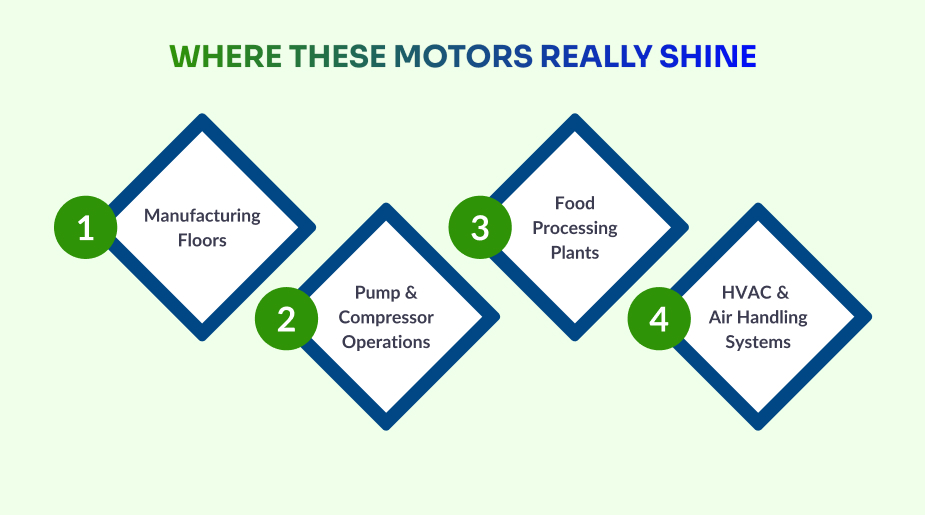
Manufacturing Floors
Walk through any modern manufacturing facility, and you’ll spot flange motor units everywhere.
They’re the go-to choice for conveyor systems, packaging lines, and material handling equipment.
The compact design lets you fit equipment into spaces where traditional motors just won’t work.
Pump and Compressor Operations
If you’re running pumps, you’re going to love the flange mounted gearbox with motor setup.
Mounting directly to the pump housing cuts out unnecessary components, reduces potential leak points, and keeps everything aligned for maximum seal life.
Compressor applications get the same benefits especially when it comes to handling vibration.
Food Processing Plants
Anyone working in food and beverage knows how challenging the sanitary requirements can be.
The flange motor design makes perfect sense here. That sealed mounting interface keeps contamination out, and the compact profile makes thorough cleaning around equipment so much easier.
When you need stainless steel construction, you’ve got those options too.
HVAC and Air Handling Systems
Fan and blower assemblies work beautifully with flange motor technology.
Direct drive eliminates belt-related efficiency losses, and the solid mounting keeps everything running quietly.
Whether you’re handling commercial or industrial ventilation, these motors deliver.
Getting to Know Your Flange Options

When you’re shopping for a flange motor, you’ll encounter different electric motor flange types.
Don’t let the variety intimidate you each type serves a purpose:
C-Face Flanges are your standard workhorses with NEMA or IEC bolt patterns. They handle most general industrial applications without breaking a sweat.
D-Flanges come with smaller diameters, making them perfect for pump applications and tight spaces where every millimeter counts.
FF-Flanges are the heavy hitters large diameter flanges built for applications that demand maximum rigidity and can handle serious loads.
Choosing the right flange-type motor comes down to matching your specific needs with the appropriate design. When in doubt, talk to your motor supplier. They’ve seen it all.
Getting Your Dimensions Right
Here’s where attention to detail really pays off. Flange motor dimensions need to match your equipment exactly, or you’re in for frustration. Pay close attention to:
Flange diameter: This determines your bolt circle and mounting surface
Pilot diameter: Crucial for proper centring
Shaft extension: Has to work with your coupling or direct-drive setup
Overall length: You need adequate clearance, especially in tight spots
Bolt hole pattern: Must line up perfectly with your equipment
NEMA and IEC standards provide excellent reference points, but don’t hesitate to ask about custom configurations if standard sizes don’t quite fit your application.
How to Pick the Perfect Motor
Power and Speed Considerations
Start with the fundamentals: what horsepower do you need, and at what speed?
Flange motor options run the gamut from fractional horsepower units for light-duty applications all the way up to massive motors pumping out hundreds of horsepower.
Speed-wise, you’ve got choices ranging from low-RPM gear assemblies to high-speed direct drives.
Think About Your Environment
Operating conditions should drive your motor selection.
What temperature extremes will the motor face?
Is moisture or humidity a concern?
Are there corrosive chemicals in the air?
Do you need explosion-proof certification?
How often will the motor face washdown procedures?
Understanding Your Load Profile
Is your application running 24/7, or does it cycle on and off? Do loads vary, or stay pretty constant?
These questions matter because they affect thermal ratings and construction requirements.
For demanding continuous operations, you might want to look at premium efficiency options like an ABB motor the initial investment pays for itself in reliability.
Installing It the Right Way

Getting the most from your flange motor starts with proper installation. Please check the below:
Check that the Surface is clean mounting surfaces are spotless, flat, and free from any burrs or paint buildup that could throw off alignment
Don’t Skip the Gasket.
Use the right gasket to seal that flange interface and keep contaminants where they belong outside
Flange motor configurations are quite maintenance-free when compared with some other designs. However, it is still wise to keep an eye following:
Vibration levels should be monitored, in case of an increase, it needs to be investigated
Mounting bolt torque should be checked from time to time, especially after the first few months.
Seals and gaskets need to be examined for the presence of wear
The manufacturer’s lubrication schedule should be followed without fail
Operating temperatures and current draw should be monitored for early warning signs
Conclusion
The flange motor is not a brand new technology but rather a reliable solution that simply works better for more applications.
The benefits of space-saving, alignment ease, and installation simplicity are all factors that you will realize immediately.
Less maintenance, fewer problems, more reliability these are just a few reasons why flange motors are preferred.
Frequently asked questions (FAQs)
Q1. What is a flange motor and how is it different from a foot-mounted motor?
A. The flange motor is mounted directly to the equipment using a circular flange instead of feet. This design allows perfect alignment, saves space, reduces vibration, and improves long-term reliability compared to traditional foot-mounted motors.
Q2. Why are flange motors preferred for industrial machines?
A. Flange motors offer compact installation, better shaft alignment, improved stability, and easier maintenance. These advantages make them ideal for conveyors, pumps, compressors, and other high-precision industrial applications.
Q3. Where are flange motors commonly used?
A. Flange motors are widely used in manufacturing lines, pump and compressor systems, HVAC applications, food processing plants, and material-handling equipment due to their direct-mounting capabilities and vibration-free performance.
Q4. What are the different types of motor flanges available?
A. Common flange types include C-Face flanges for general industrial use, D-Flanges for compact pump applications, and FF-Flanges for heavy-load operations. Each flange type supports specific mounting and performance requirements.
Q5. How do I choose the right flange motor for my application?
A. Consider factors like horsepower, operating speed, flange dimensions, environmental conditions, load profile, and mounting pattern. Matching the flange diameter, pilot diameter, and shaft length with your equipment ensures proper installation and performance.