The selection of an appropriate motor goes beyond technical requirements and whether you are selecting single phase motors or three phase motors, both come with their own set of advantages and disadvantages.
Your selection of a single-phase or Three-Phase motor determines all aspects of your operations, from efficiency to operational expenses and future maintenance needs.
People find it difficult to understand how a motor works, but they need to select based on their actual requirements and the electric motor power capacity available at their location.
Let us explore how these two machines differ from one another.
Difference between Single-Phase Motor and Three-Phase Motor
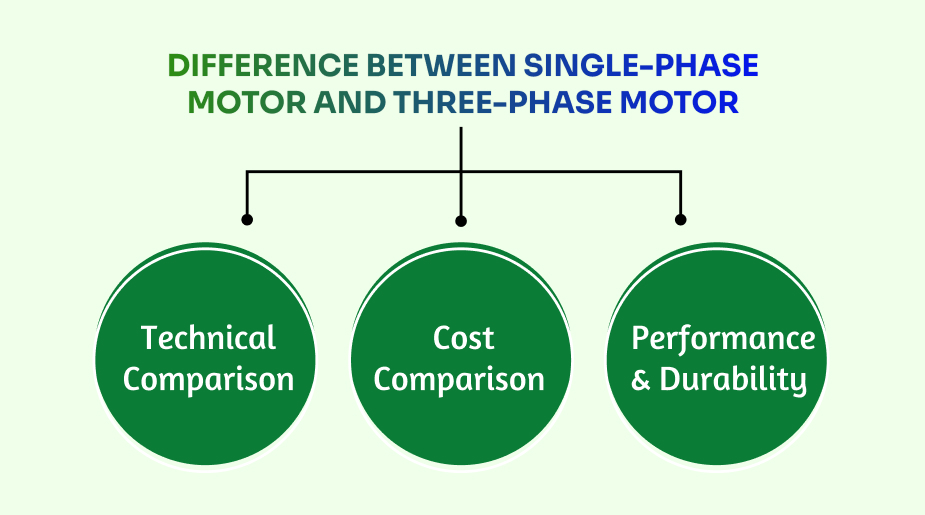
Single-Phase Motor and Three-Phase Motor operate with different methods for power distribution.
The Single-Phase motor operates like a single rower who uses his strength for one movement before he prepares himself to row the boat again.
But the Three-Phase motor operates like three rowers who work together to maintain the continuous motion of their boat.
Technical Comparison
Single-Phase Motor: A Single-Phase motor operates with an alternating current (AC) supply. The motors require auxiliary components, which include capacitors and start-windings, so that the motor can achieve rotor movement.
It is necessary because their power delivery system reaches a “zero point” twice during each operating cycle. A single phase induction motor also works in a similar way.
A three-phase motor creates a rotating magnetic field through three alternating currents, which maintain a phase difference of 120 degrees between each current.
The motor can start by itself because it maintains power at all times, thus requiring no extra auxiliary component.
The system delivers continuous torque while operating at maximum energy efficiency, which makes it suitable for heavy industrial applications.
Cost Comparison
Single-Phase Motor: The initial analysis shows that Single-Phase motors provide lower costs because their motor price and wiring requirements cost less, but their actual costs become higher when used for projects that require high-horsepower performance.
That is why, even a 2HP single phase motor is going to be available at a lower price than many three phase motors.
Three-Phase motors require more power to run. The three-phase power line installation cost surely comes with a financial burden to those facilities that don’t have existing infrastructure, but these costs will be covered up in the future because three-phase systems operate at higher energy efficiency.
Performance and Durability
Single Phase Motor: Single phase motors, like the 3hp single phase motor, drives its operations through pulsing force which produces both vibrations and sound emissions.
The single phase induction motor model needs both capacitors and switches for its operations but these components will eventually experience deterioration.
A single phase motor connection provides reduced starting torque performance when compared to other motor connections.
Three Phase Motor: The 3 phase induction motors deliver smooth operation with no vibrations, which makes them perfect for demanding industrial environments.
The system achieves better operational performance because it uses components that do not experience wear.
It is also manufactured to handle heavy loads with its high starting torque, which makes it the preferred equipment for ongoing industrial work at high operational levels.
Range of Single Phase Motors and Three Phase Motors Applications
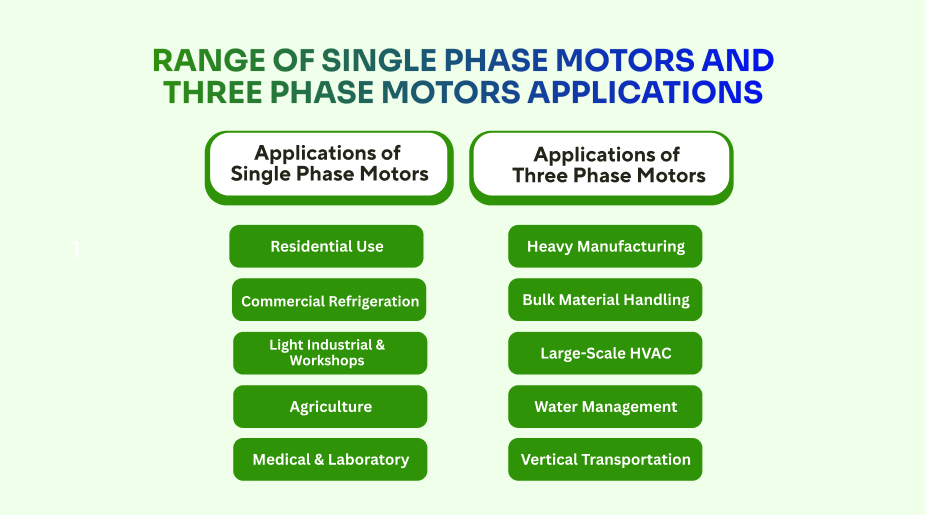
Applications of Single Phase Motors
Single-phase motors serve as the ideal solution for facilities that require them to operate their machines at typical power levels.
Residential Use: Essential household appliances, which include washing machines and dryers and vacuum cleaners and ceiling fans, require electrical power from this system.
Commercial Refrigeration: The system operates compressors that power display cases and reach-in coolers and ice machines that restaurants and convenience stores use.
Light Industrial & Workshops: This equipment serves as the main electrical power supply for table saws and drill presses and grinders and small air compressors. When exploring the types of single phase induction motor, one can easily find that these motors are one of the most common motors for light industrial and workshop use.
Agriculture: The system powers portable equipment, which includes grain augers and automated poultry feeders and liquid manure pumps that operate in areas without 3-phase power distribution.
Medical & Laboratory: The system powers dental vacuums, centrifugal separators and oxygen concentrators, which require standard wall outlets for their operation.
Applications of Three Phase Motors
Three-phase motors operate in industrial facilities that need their systems to run nonstop while achieving maximum operational efficiency and delivering maximum torque output.
Heavy Manufacturing: Heavy manufacturing facilities operate different types of CNC machines and lathes and hydraulic presses, which need to maintain constant operational speed when handling their maximum weight capacity. That is why we cannot use a 2HP single phase motor for such heavy usage.
Bulk Material Handling: Bulk material handling systems use their power to operate lengthy conveyor networks that extend through mining sites and airports and large distribution centers.
Large-Scale HVAC: Large-scale HVAC systems operate their powerful chillers and industrial blowers which maintain the climate in skyscrapers and hospitals and shopping malls.
Water Management: Water management systems use their power to operate high-capacity vertical turbine pumps which serve municipal water treatment facilities and large agricultural irrigation systems.
Vertical Transportation: Vertical transportation systems operate all commercial centers through their high-speed elevators and heavy-duty escalators which provide safe passenger movement through controlled start-and-stop operations.
Advantages and Limitations
| Feature |
Single-Phase |
Three-Phase |
| Advantages |
Widely available
Low initial cost
Simple wiring |
Highly efficient
Self-starting
Lasts longer
Smaller frame |
| Limitations |
High power loss
Capacitors/switches wear out
Lower starting torque |
Requires a 3-phase power supply
Much higher setup cost |
Why Single Phase Motors Are the Right Choice for You
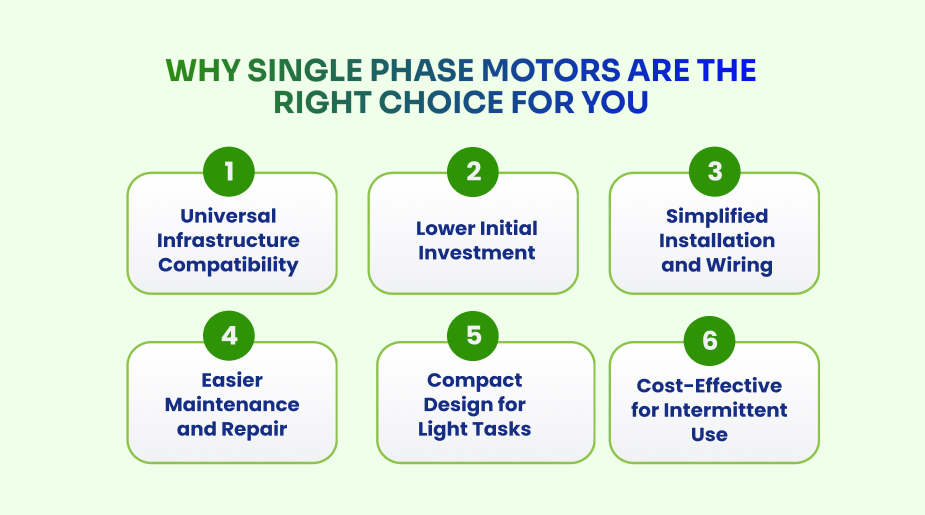
While selecting a motor, one needs to create a balance between their industrial power requirements and the most effective solution for their particular operational setting. However, single-phase motors remain the most popular choice for a variety of reasons:
Universal Infrastructure Compatibility: The primary benefit of these motors lies in their ability to operate on standard electrical grids that exist in residential, commercial and small workshop environments.
Users only need to connect it to existing power sources without needing costly electrical system enhancements or specialized industrial energy systems.
Lower Initial Investment: Single phase motors built for low-to-medium horsepower requirements are generally available at lower prices.
This makes them an ideal option for startups or DIY enthusiasts who want to keep their investment costs to a minimum.
Simplified Installation and Wiring: The wiring system of a single phase motor is much less complex than the 3 phase induction motor.
Single phase motors only require a simpler power system because they are built with two power wires and a ground connection for earthing.
Easier Maintenance and Repair: The replacement parts of these motors are easy to find in the market. Also, the single phase motors are less complex, so most electricians can repair them quickly, which reduces the operational downtime.
Compact Design for Light Tasks: These motors are perfectly built for smaller machinery. They are designed to generate the necessary torque for the common electrical tools like pumps, fans and saws, and they don’t require a heavy, costly industrial setup.
Cost-Effective for Intermittent Use: The higher energy efficiency and benefits of a three-phase motor system does not provide a significant return on investment when your equipment operates less than 24 hours.
The direct operational advantages of a single-phase motor make it the most economical choice for your needs.
Conclusion
The correct motor selection will determine your future success. Single phase motors have become the standard solution for both commercial and residential applications.
At Shri Rang Energy Efficient we provide more than hardware; we design efficient solutions.
Our company has spent more than 17 years working in Gujarat to create the highest quality single phase motors to operate under local power variations.
Our team provides assistance to clients who need help with their workshop operations and commercial project work.
Contact us today if you want to reduce energy expenses while using our most dependable technology to boost your operational efficiency.
Frequently asked questions (FAQs)
Q1. What is the main difference between a single-phase and a three-phase motor?
A. Single-phase motor runs on single-phase AC power and needs capacitors to start, while a three-phase motor uses three currents to create continuous torque and higher efficiency.
Q2. Which motor is more energy-efficient for industrial use?
A. Three-phase motors are more energy-efficient and deliver constant power, making them ideal for heavy industrial machinery and continuous operations.
Q3. Are single-phase motors cheaper than three-phase motors?
A. Yes, single-phase motors usually have a lower initial cost and simpler wiring. However, three-phase motors can be more cost-effective long-term for high-power applications.
Q4. Where are single-phase motors commonly used?
A. They are widely used in homes, small workshops, agriculture equipment, compressors, pumps, fans and light commercial machinery where heavy power isn’t required.
Q5. How do I choose between a single-phase and three-phase motor?
A. Choose based on available power supply, required horsepower, runtime, efficiency needs and budget. Small or intermittent use suits single-phase, while heavy loads need three-phase.