Energy consumption is not a line item on an expense report anymore. It’s an important parameter for the competitiveness of modern industries.
Because electric motors represent nearly 70% of industrial power, the drives must be efficient.
This article shows how Siemens motors use advanced engineering from better magnetic materials to optimised rotor designs to reduce energy wastage.
See the technical synergy between motors and variable frequency drives, calculate the utility bill impact of IE3 and IE4 standards and help you choose the right equipment for long-term viability.
Key Takeaways: Siemens Motors
- Operational Savings: Purchase price is a fraction of lifecycle cost; Switching to high-efficiency motors pays for itself in less than two years through electricity savings.
- Technological Edge: Copper rotors and precision-engineered air gaps in the Siemens Simotics range reduce internal losses much better than standard motors.
- System Integration: Siemens motors paired with a Sinamics VFD (Variable Frequency Drive) enables precise speed control, reducing energy consumption by up to 50% in pump and fan applications.
- Standards Compliance: Siemens electric motors in India meet and often exceed global efficiency standards IE3 Premium/IE4 Super Premium.
- Reduced Maintenance: Greater efficiency implies lesser heat generation, corresponding to an increased insulation life and lower bearing failure rates.
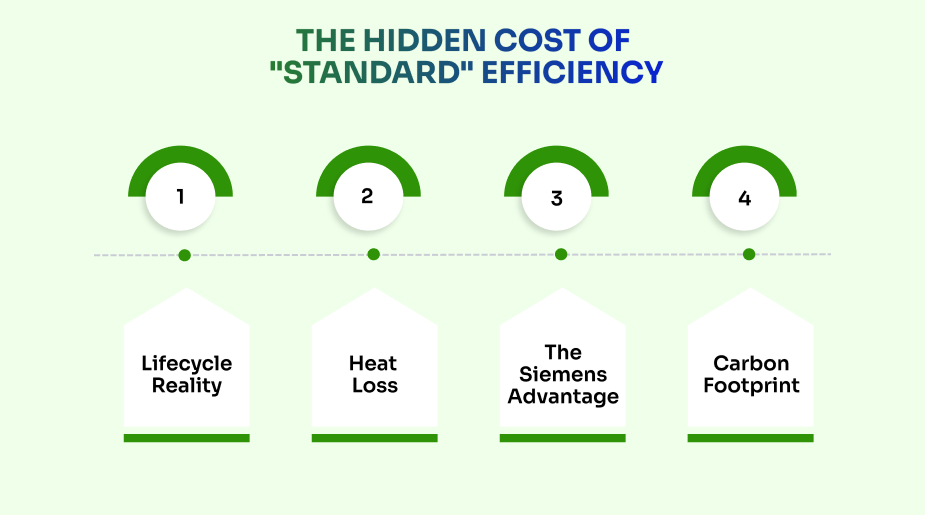
The Hidden Cost of “Standard” Efficiency
Many plant managers focus only on the initial procurement cost. It is cheaper upfront to buy a standard efficiency motor than to pay for every hour the motor runs. This “sticker price mentality” is a huge barrier to profit.
- Lifecycle Reality: In its average 15-20 years of life, motor electric consumption makes up about 95% of its cost. The purchase price is often less than 3%.
- Heat Loss: Inefficient motors waste energy mostly as heat. That adds to the electric bill and also places additional load on facility cooling systems.
- The Siemens Advantage: Facilities can cut these losses by upgrading to Siemens motors. A 3-4% efficiency gain on a 100kW motor running continuously brings huge annual savings.
- Carbon Footprint: Above all else, they save companies money by lowering indirect CO2 emissions.
Engineering Excellence: Inside the Simotics Series
What actually differentiates Siemens motor dealer from a generic competitor? It isn’t magic; It’s materials science and precision manufacturing.
Siemens refined the induction motor design for decades to get every watt of performance.
- Copper rotors: Some high-efficiency Siemens units use copper instead of aluminium Rotors. Copper has lower electrical resistance, which decreases rotor losses.
- Optimised Laminations: The stator core uses premium silicon steel with thinner laminations. That lowers eddy-current losses and hysteresis, and the magnetic field builds up with less energy.
- Precision Air Gaps: The rotor/stator gap is machined to very tight tolerances. A narrow, consistent air gap improves magnetic flux and power factor.
- Aerodynamic Cooling: The cooling fans of Siemens motors move the maximum amount of air with minimal resistance, reducing the mechanical load on the shaft itself.
The Power of Synergy: Motors and VFDs
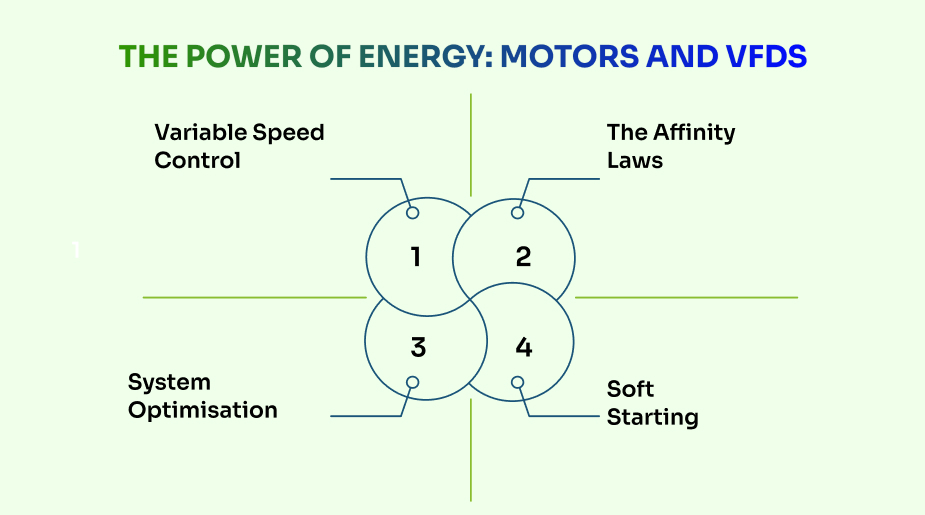
Having an effective motor is only half the battle. Even if you run a high energy efficient motor at full speed with a closed valve or damper, you still waste energy.
The full potential of Siemens motors in India is revealed when paired with intelligent control systems.
- Variable Speed Control: Applications like pumps and fans seldom need to be at 100% capacity all day. A Sinamic VFD adjusts motor speed to meet demand.
- The Affinity Laws: For centrifugal loads, a reduction of 20% of motor speed can save energy up to 50%.
- System Optimisation: Siemens designs its motors and drives as talking devices. This integration guarantees the motor to work under the best efficiency curve in all working-speed ranges.
- Soft Starting: These massive in-rush current spikes at startup are removed by VFDs, which shield both the motor windings and the factory electrical grid.
Understanding Efficiency Classes: IE3 and IE4
The global standard for motor efficiency is IEC 60034-30-2, which defines International efficiency classes. Knowing these is key to purchasing decisions.
- IE2 (High Efficiency): In many places, this is the minimum. Better than old standard motors, but getting old fast.
- IE3 (Premium Efficiency): Siemens motors in the IE3 class are the industry standard for new installations. Their ROI is excellent for continuous duty application.
- IE4 (Super Premium Efficiency): These are the ultimate IE4 induction motors. They are expensive upfront, but with very low losses, they are the smartest financial choice for 24/7 equipment.
- Compliance in India: As industries modernise, government mandates as well as corporate sustainability goals are driving demand for Siemens electric motor rated IE3 + in India.
Reliability and Thermal Management
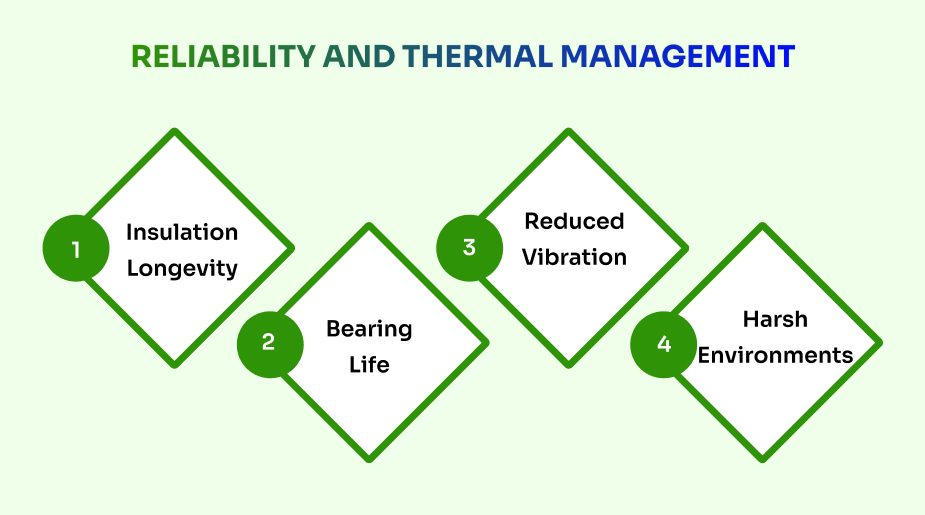
Durability is often overlooked in favour of high efficiency. The enemy of electrical components is heat.
Siemens electric motors convert more energy to motion and less to heat – so they run much cooler than standard motors.
- Insulation Longevity: At a 10°C drop in operating temperature, the life of the motor’s insulation windings doubles. That means fewer rewinds & burnouts.
- Bearing Life: Cooler operation keeps the bearing grease viscous, reducing friction and prolonging maintenance intervals.
- Reduced Vibration: The precision balancing needed for the high efficiency also leads to smoother operation that imposes less mechanical stress on the driven equipment (pumps, gearboxes, etc.).
- Harsh Environments: The robust thermal management enables such motors to work reliably even at high ambient temperatures typical of Indian industrial zones.
Partnering for a Greener, Profitable Future
We strongly believe that upgrading your industrial drive systems is one of the best ways to safeguard your bottom line.
And here at Shri Rang Energy Efficient we provide more than hardware. We design efficient solutions.
For more than 17 years now, we have been serving as a partner to industries all across Gujarat in meeting their energy conservation needs.
As one of the top Siemens motor dealers in Ahmedabad, we carry a complete lineup of Simotics motors to suit any application.
Whether you want to retrofit an ageing textile plant with IE3 Siemens motors or need specialised Siemens motors for a new pharmaceutical line, our technical team is here to help you.
We understand your local industry challenges and can help you calculate the ROI of upgrading your infrastructure.
Contact Shrirang Enterprise, and let’s work on lowering energy costs & increasing productivity.
Frequently asked questions (FAQs)
Q1. How do Siemens motors improve energy efficiency in industries?
A. Siemens motors use high-grade magnetic materials, copper rotors, optimized air gaps, and aerodynamic cooling to reduce losses. When paired with Sinamics VFDs, they adjust speed to demand and significantly lower power consumption.
Q2. What is the benefit of IE3 and IE4 Siemens motors?
A. IE3 (Premium Efficiency) and IE4 (Super Premium Efficiency) motors deliver higher efficiency than standard motors, reducing electricity bills and lifecycle costs. They are ideal for continuous-duty industrial applications with faster ROI.
Q3. Can Siemens motors reduce energy costs in pumps and fans?
A. Yes. When combined with a Siemens VFD, motors can reduce speed based on load. For centrifugal loads like pumps and fans, energy savings can reach up to 50% compared to fixed-speed operation.
Q4. Are Siemens motors suitable for Indian industrial conditions?
A. Siemens electric motors meet global IE3/IE4 standards and are designed for high ambient temperatures and heavy-duty environments, making them reliable for Indian manufacturing and process industries.
Q5. Do high-efficiency Siemens motors require less maintenance?
A. Yes. Improved efficiency means less heat generation, which extends insulation life, reduces bearing wear, and lowers maintenance frequency, resulting in improved uptime and long-term savings.