With the ever-changing landscape of industrial automation, one critical component often determines the efficiency of mechanical systems, i.e, the gear motor
Combining a DC motor and gear reduction system, these units deliver precise torque and speed control for demanding applications ranging from heavy-duty conveyors to delicate robotics.
This article reviews the engineering principles of gear motors, their classifications and practical tips on how to choose the best unit for industrial applications, ensuring operational longevity and low cost.
Overview
- Definition: A gear motor is actually just an electric motor combined with a gearbox (gear reducer). This integration reduces the output speed of the motor but increases torque.
- Key Function: They are designed as torque multipliers. A small motor can move much heavier loads by changing the gear ratio.
- Common Applications: Power conveying belts, automatic door operators, medical equipment, automotive components (like windshield wipers) and robotics.
- Main Types: Helical, Planetary, Worm, Bevel gear motors are industry standard categories, suitable for particular spatial and load conditions.
- Selection Criteria: When choosing a unit, engineers mostly consider torque requirements, output speed (RPM), voltage (e.g. 12V, 24V, 415V), and the operating environment (temperature, dust, moisture) when choosing a unit.
What Is a Gear Motor?
At its core, a gear motor is an efficient device. Unlike most standard motors, which spin too fast to be directly useful, gear motors step down that speed using gears.
This reduction is not about slowing things down. It is about power conservation. The torque increases with speed.
This means that for facility managers and OEMs, it is possible to use a smaller, more energy-efficient motor to drive a big load if the gearing is correct.
That efficiency explains their widespread application in food and beverage processing, material handling and heavy manufacturing.
Why Gear Motors Are Important in Industrial Applications
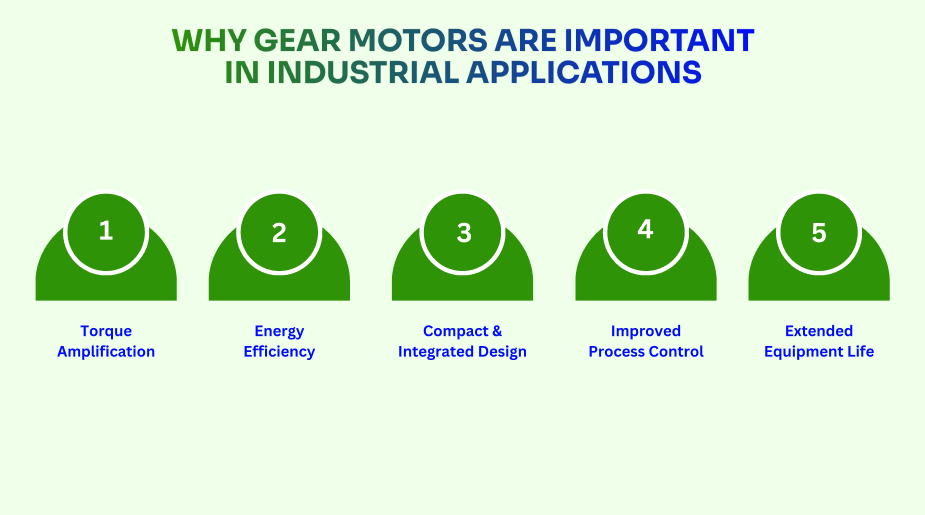
1. Torque Amplification
The purpose of a gear motor is to take the low torque-high speed output from the electric motor and turn it into the high torque-low speed output required for most machine movement; thus, machines can move large amounts of material with ease.
2. Energy Efficiency
A gear motor matches the required speed and torque at all times (due to its fixed ratio), and therefore uses less energy than an open drive system with variable ratios.
3. Compact & Integrated Design
With both the motor and gearbox being part of one unit, a gear motor reduces the space needed for installations and minimises the potential misalignment problems associated with separate motor-gearbox assemblies.
4. Improved Process Control
Stable speed control is essential when operating in automation lines, packaging systems or continuous production; this is where gear motors provide consistent performance.
5. Extended Equipment Life
Less mechanical stress on components and better-controlled torque will lead to longer-lasting systems and higher overall system reliability.
Different Types of Gear Motors Explained
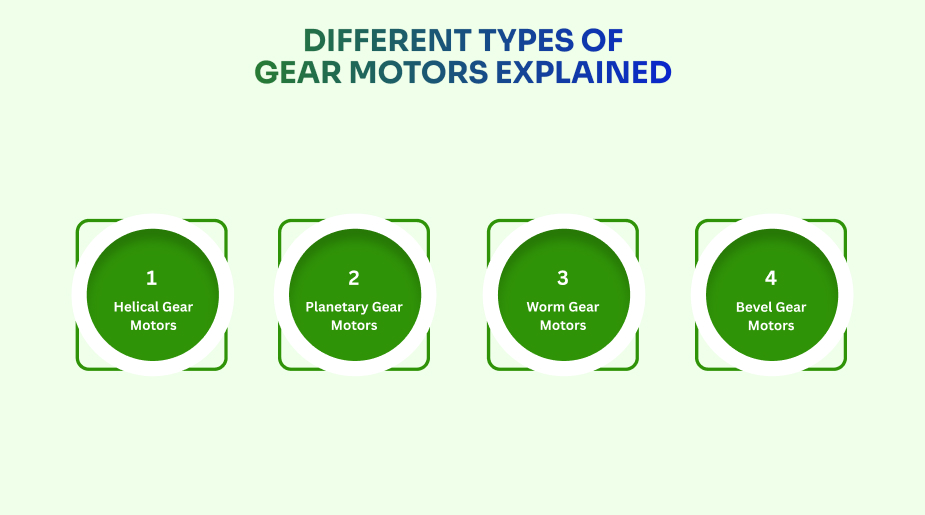
Selecting from the many options for gear motors can be daunting. However, most options fit into one or all of four categories with unique advantages:
- Helical Gear Motors
Helical geared motors are the type of gears most commonly used by industries. These helical gears are at an angle, allowing for a gradual contact between the gears, resulting in quieter operation and a higher torque capacity than those found on spur gears.
Key Benefits
- Gradually engaging the gears results in significantly reduced noise levels.
- Can handle larger loads than spur gears, as well as provide longer life.
- Ideal for high-volume, heavy-duty industrial cycles that do not cause the motor to overheat.
Common Uses: High volume, heavy-duty industrial operations.
- Planetary Gear Motors
These are extremely dense for power. The use of an input shaft to turn a sun gear about planet gears is used in planetary gear motors.
This type of motor’s small footprint makes it possible to create large amounts of torque using a small motor; however, due to the placement of the load on multiple teeth, the design also allows for very little energy loss when transmitting the load.
Key Benefits
- Has an extraordinary amount of power based on its size.
- It can generate a high level of torque in a smaller, lighter form factor.
- Due to the load being distributed among multiple teeth, the design provides a reliable and efficient method of transmitting loads with minimal energy loss.
Common Uses: Precision robots.
- Worm Gear Motors
Worm gear motors are an alternative method of creating motion, using a screw-like gear (worm) to produce motion at a wheel.
They offer high reduction ratios and compact designs, which provide advantages in applications that require both of these features.
Worm gear motors have the added benefit of providing self-locking when the motor’s output shaft tries to turn the motor backwards; the motor locks to prevent turning by the motor’s output shaft.
Key Benefits
- Prevents back driving and offers a safe braking option with a built-in braking system.
- Provides a large amount of speed reduction through one gear stage.
- Offers a compact design to allow for use in areas that are too narrow for larger gearbox units.
Common Uses: Elevators, hoists.
- Bevel Gear Motors
These gear motors are generally used to change the orientation of the motor’s output shaft, typically to 90°. They offer both reliability and durability.
Key Benefits
- Transforms the orientation of the motor’s output shaft (typically 90°).
- Provides ruggedness that is designed to endure significant amounts of wear and tear.
- Transmits reliable power even when operating under heavy loads.
Common Uses: Rock crushers, mixer applications.
How to Choose the Right Gear Motor
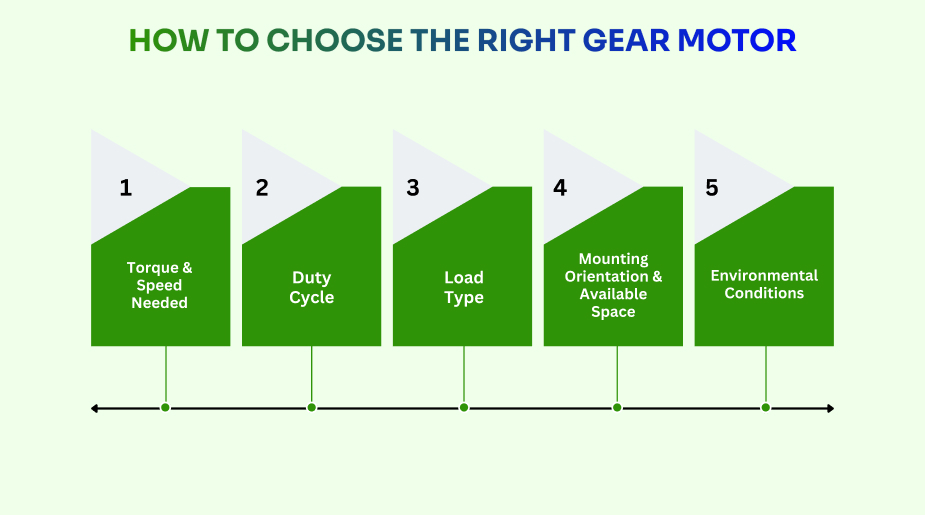
The first thing that is often overlooked when choosing a gear motor is the motor’s ability to deliver enough power. Therefore, before choosing a gear motor, take into account the following:
- Torque and Speed Needed: If you have a torque requirement that is lower than what your motor provides, your motor will stall. Likewise, if your motor can provide a greater torque than your load, you may lose some of the precision with which you are trying to achieve.
- Duty Cycle: Determine how long you plan on having your motor run continuously versus intermittently. If you are going to have a motor running continuously, you will want to choose a motor that has good thermal dissipation so that it does not overheat.
- Load Type: Determine if your load remains constant while your motor operates or if your load varies while your motor is in use. Loads that vary from their rated value at start-up or while running require a motor that has a good dynamic response.
- Mounting Orientation and Available Space: Determine where you are going to mount your motor and what space constraints you have. For example, are you going to mount the motor vertically or horizontally? Are there physical space constraints that limit the size of your motor? This could potentially lead to using a motor that uses a compact type of gear drive, such as a worm or bevel gear motor.
- Environmental Conditions: Determine the environmental conditions under which you will be operating your motor. Is it dusty? Is it wet? Does it operate in extreme temperatures? Operating conditions such as these may call for an IP-rated sealed motor or special
Small-Scale and Precision Applications
Not all gear motors are giant, heavy industrial units. A common 12V gear motor is found in all micro-automation/automotive auxiliaries.
These are small but tough DC-powered units. You’ll find them adjusting seats in your car, distributing tickets in kiosks, or driving the wheels of a self-driving vehicle in a smart warehouse. Their low voltage makes them safe and simple to add to battery-powered devices.
Future Trends in Gear Motor Technology
Smart Motion is the new industrial standard. Gear motor technology is becoming more than mechanical reduction as we move further into 2026.
- Integration with VFDs and Smart Drives: Modern systems often combine gear motors with Variable Frequency Drives (VFDs) for dynamic speed control. Such an integration enables “Soft Starts,” reducing mechanical stress and reducing up to 50% energy consumption for variable-load applications like pumping or ventilation.
- Energy-Efficient IE3 & IE4 Motor Standards: With global regulations getting tighter, there is a huge shift to IE3 for premium efficiency and IE4 motors for super premium efficiency. These motors use premium materials and optimized magnetic designs to minimize internal heat losses for a fast payback in reduced electric bills.
- Condition Monitoring using IoT Sensors: Predictive Maintenance is a term used in the Industrial Internet of Things/IIoT. With vibration, temperature and torque sensors embedded directly into the gearbox, operators can detect early bearing wear or lubrication failure before the breakdown occurs.
- Compact Designs for Industry 4.0 Automation: Factory designs are becoming more modular and robotic, so high-power-density units such as planetary gear motors are in high demand. They fit in smaller footprints yet provide high torque for precise, automated assembly lines.
Final Thoughts
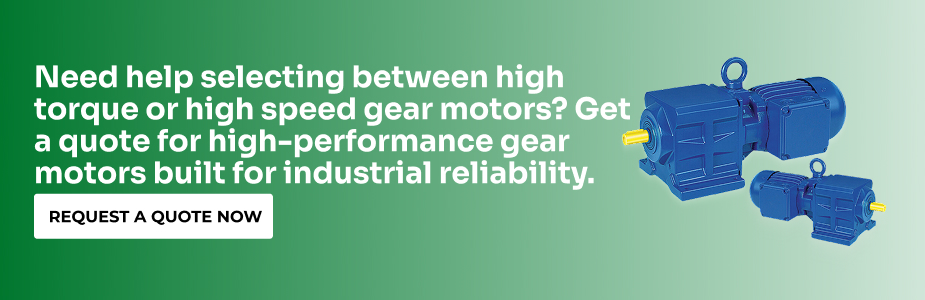
Choosing the right gear motor influences your machinery’s efficiency and reliability. Whether you need the heaviest-duty high-torque unit for a conveyor or the smallest precision 12V motor for automation, you need to know the technical requirements for your application.
Prioritising quality and matching the gear type to your operation ensures smooth performance and lower maintenance costs.
We at Shri Rang Energy Efficient recognize that each and every industrial site is different when it comes to its needs in terms of power transmission. With Shri Rang as an authorized dealer for international companies such as Bharat Bijlee, ABB, Siemens and Havells, we offer a variety of top gear motors.
In addition to standard gear motors, we also specialize in the supply of FHP (Flat-Top Horizontal-Pedestal) vertical gear motors and helical geared motors.
Frequently asked questions (FAQs)
Q1. What is a gear motor?
A. The gear motor is an electric motor combined with a gearbox that reduces speed and increases torque, making it ideal for industrial and automation applications.
Q2. What are the main types of gear motors?
A. The main types of gear motors are helical, planetary, worm, and bevel gear motors, each designed for specific load, speed, and space requirements.
Q3. Where are gear motors commonly used?
A. Gear motors are widely used in conveyors, robotics, elevators, packaging machines, food processing, automotive systems, and material handling equipment.
Q4. How do I choose the right gear motor?
A. You should consider torque, speed (RPM), duty cycle, load type, mounting space, voltage, and environmental conditions before selecting a gear motor.
Q5. Why are gear motors important in industrial applications?
A. Gear motors improve energy efficiency, provide high torque at low speeds, reduce mechanical stress, save space, and enhance equipment lifespan.